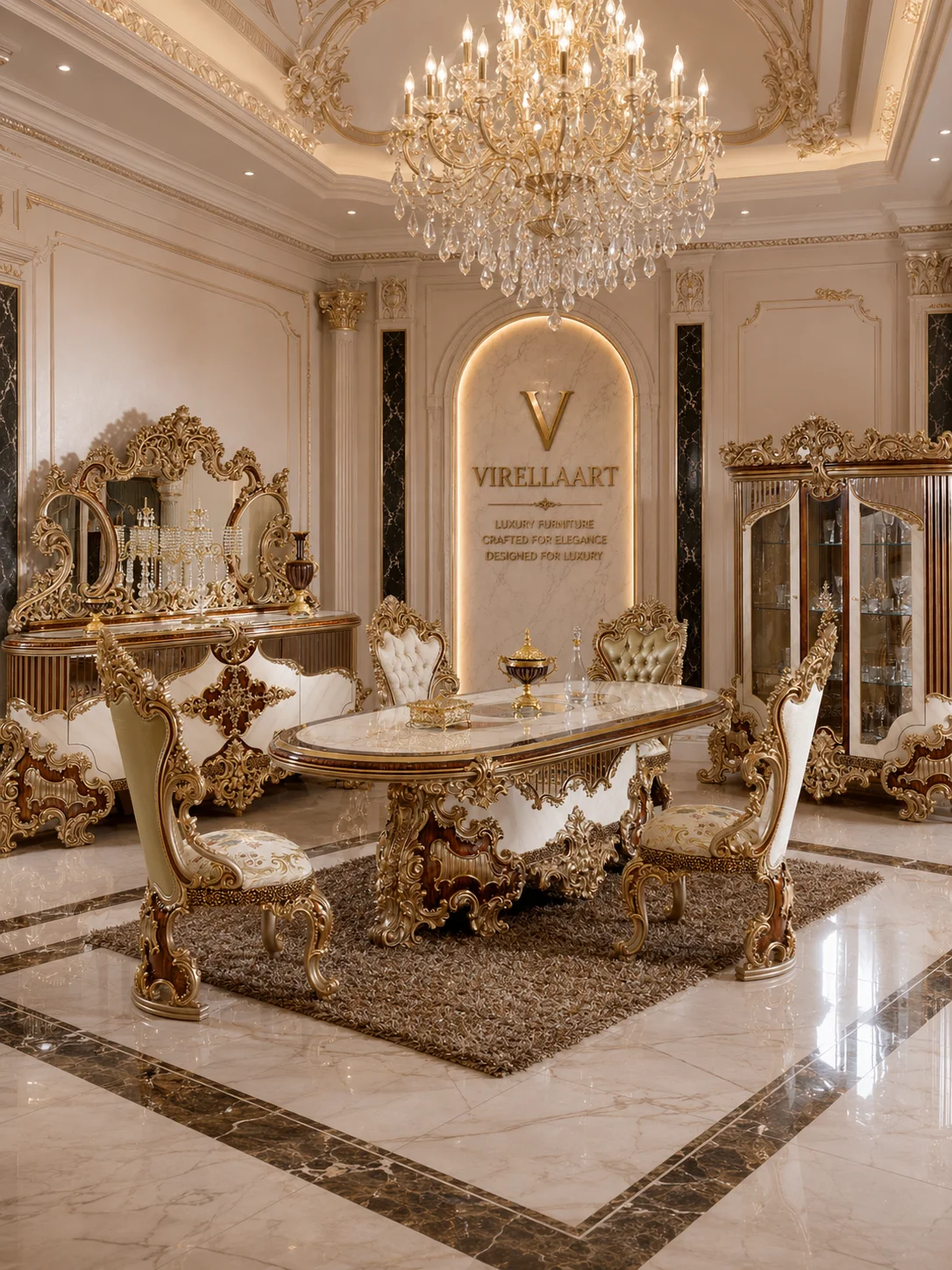
The essential decision
A dining table is where the household gathers most often, and where guests form their first real impression of a residence's character. It's chosen as the anchor of a room that's already been thought through — not in isolation.
A dining table carries more weight in a home than almost any other piece of furniture. It's where the household gathers most often, and where guests form their first real impression of a residence's character. Choosing the right one is less about following trends and more about matching the table to how the room — and the people in it — actually live.
1. Start with the room, not the table
Before looking at any specific piece, measure the space honestly. A dining table needs at least 90–100 cm of clearance on every side for chairs to pull out and for people to walk past comfortably. In smaller dining rooms, an oversized table doesn't read as luxurious — it reads as crowded. The most refined dining rooms leave breathing room around the table, not just at it.
Consider also how the table will be used day to day. A household that hosts often may want a table that can extend or accommodate additional seating. A household that dines primarily as a family of four may prioritize a more intimate, tightly proportioned set instead.
2. Material defines the room's character
Material is where a dining table's personality comes through most clearly.
Solid wood with hand-finished detailing brings warmth and a sense of permanence. It's the classic choice for dining rooms built around craftsmanship and traditional elegance — the kind of piece that's meant to be passed down, not replaced.
Marble and stone tops bring a cooler, more architectural presence. They photograph beautifully and pair well with contemporary interiors, though they demand more careful maintenance than wood.
Metal accents and detailing — gold or bronze finishes on legs, edges, or bases — are what elevate a dining set from simply well-made to genuinely luxurious. Detailing at this level is usually where the difference between a mass-produced set and a made-to-order piece becomes obvious.
The VIRELLAARTSaltanat Dining Room Setis a clear example of this approach: hand-finished in Istanbul with classic detailing designed as a statement piece for residences where the dining room is meant to make an impression.
3. Classic vs. contemporary: choosing a direction
There's no universally "correct" answer here — the right direction depends on the rest of the home.
A classic dining room favors carved detailing, richer wood tones, and upholstered seating with structured silhouettes. It suits residences with traditional architecture, higher ceilings, or a formal entertaining style.
A contemporary dining room favors cleaner lines, simpler silhouettes, and a more restrained material palette. It suits open-plan homes and residences where the dining room flows directly into a living space.
For a refined classic option with a slightly more accessible entry point into a Signature-level dining set, theZümrüt Dining Room Setbalances traditional detailing with a scale that works well in most standard-sized dining rooms.
4. Seating: comfort is not optional
A beautiful table with uncomfortable chairs undermines the whole room. Test seat depth and back support if possible, and make sure upholstery fabric matches how the room will actually be used — a household with children may want a more resilient fabric than one that entertains primarily adults.
5. Made-to-order vs. off-the-shelf
One advantage of a made-to-order dining set is the ability to match table dimensions, wood tone, and upholstery to the exact room — rather than adjusting the room around a fixed, mass-produced piece. This matters most in dining rooms with unusual proportions, or for households assembling a full interior around a specific design direction.
6. Final luxury dining table checklist
VIRELLAART guidance
Bringing it together
The best luxury dining tables aren't chosen in isolation — they're chosen as the anchor of a room that's already been thought through: proportions, material, seating, and the overall direction of the space.
Explore the fullVIRELLAART Luxury Dining Rooms collectionto see how these principles come together in Signature-level dining sets, or reach out via WhatsApp for a private consultation on sizing and finishes for your specific space.
Frequently asked questions
Luxury dining table FAQ
How much space does a dining table need around it?
Leave at least 90–100 cm of clearance on every side so chairs can pull out and guests can walk past comfortably. In a smaller dining room, an oversized table doesn't read as luxurious — it reads as crowded.
What material should I choose for a luxury dining table?
Solid wood with hand-finished detailing brings warmth and permanence, marble and stone tops bring a cooler architectural presence suited to contemporary interiors, and metal accents on legs or edges are usually what elevate a set from well-made to genuinely luxurious.
Should I choose a classic or contemporary dining table?
The right direction depends on the rest of the home. Classic dining rooms favor carved detailing, richer wood tones and upholstered seating with structured silhouettes, while contemporary dining rooms favor cleaner lines and a more restrained palette, especially in open-plan homes.
Is a made-to-order dining table worth it?
A made-to-order set lets table dimensions, wood tone and upholstery be matched to the exact room rather than adjusting the room around a fixed, mass-produced piece — this matters most for unusual room proportions or a fully planned interior.
Does chair comfort matter as much as the table itself?
Yes. A beautiful table with uncomfortable chairs undermines the whole room, so seat depth, back support and upholstery durability should match how the household actually uses the space.