The essential decision
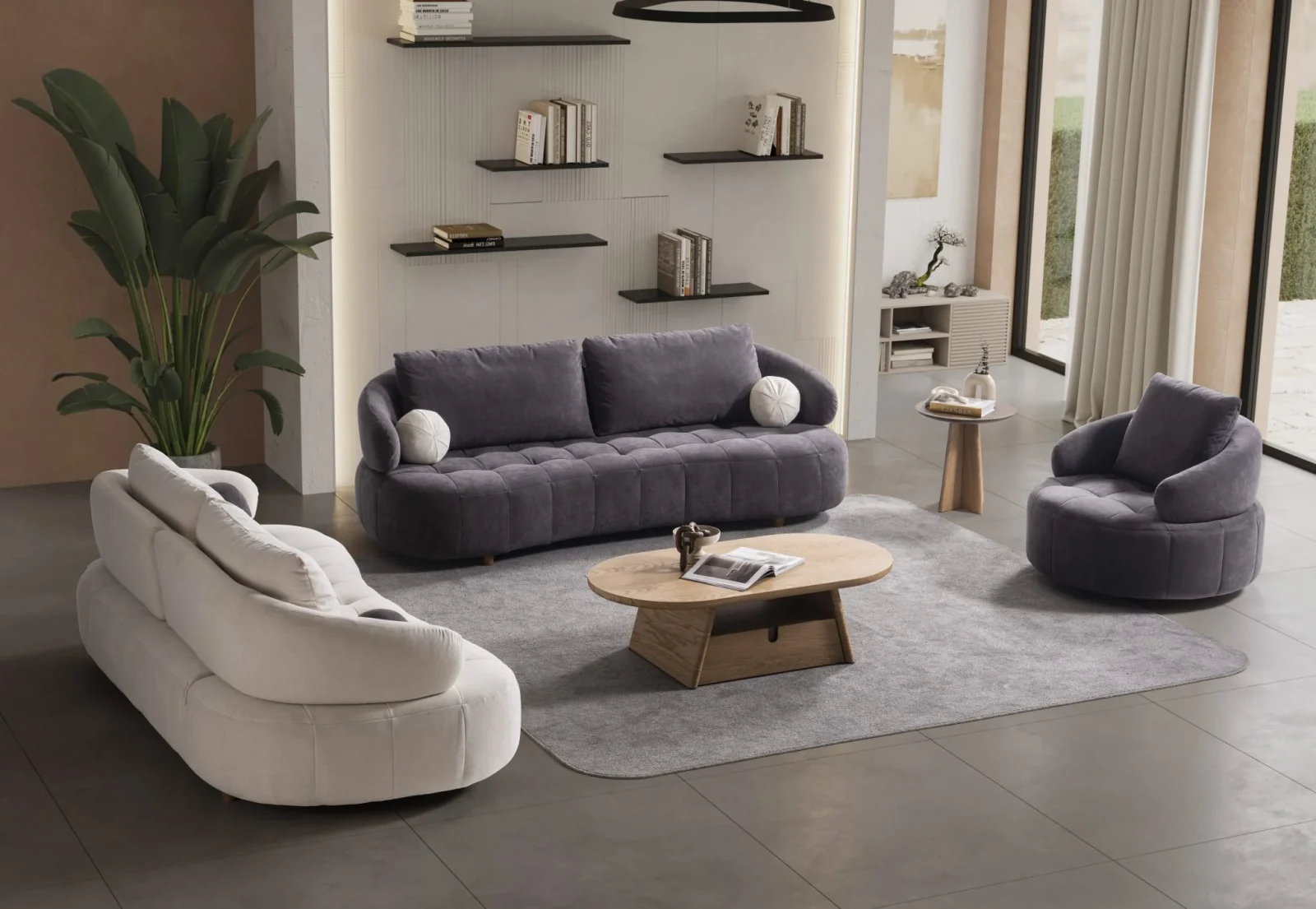
Choose the coffee table from the usable space inside the seating arrangement. Its dimensions should support access from the sofa while preserving circulation and a balanced relationship with every seat.
A coffee table is smaller than the main sofa, but its position at the centre of the room gives it considerable visual importance. A table that is too small can appear disconnected, while one that is too large can restrict movement and dominate the seating area.
The correct size depends on more than the sofa width. Sofa depth, arm shape, corner modules, armchairs, side tables and the route through the living room all affect the available table area.
1. Measure the complete seating area
Begin with the room width and length, then identify the usable floor area between the sofas and armchairs. Record the position of doors, windows, television furniture and main circulation routes.
Measure the open space after the complete external sofa dimensions have been marked. Do not calculate from the internal seat width or the edge of the rug alone.
Create a simple floor plan
Draw the seating arrangement from above and show every sofa, armchair and side table. Mark the routes used to enter the room, reach the seating and move toward adjoining areas.
Ourcomplete room measurement guideexplains how to document usable space, furniture clearances and delivery access.
2. Compare the table with the sofa proportions
The table should feel connected to the main sofa without copying its complete width. A common visual starting point is a table that occupies a substantial but controlled portion of the sofa length.
This is not a fixed rule. Wide sofa arms, sectional modules, curved silhouettes and asymmetrical layouts may require a different proportion.
Use the complete external sofa width
Include the arms and decorative projections when comparing the table and sofa. A model with broad arms may have less internal seating width even though its external dimensions are generous.
Continue with oursofa size planning guidebefore finalizing the complete seating composition.
3. Protect access and circulation
Users should be able to sit down, stand up and reach the table without moving through an excessively narrow gap. At the same time, the table should not be so distant that it becomes impractical.
Evaluate the clearance from every sofa and armchair rather than measuring only from the principal seat. Corner arrangements often create different distances on each side.
Protect the main walking routes
The coffee table should not interrupt movement between doors, seating areas, balconies and the television wall. Leave more generous circulation on the side used as the principal route.
Mark the full table footprint with removable masking tape. Walk around the outline, sit in every seat and test the room during realistic daily movement.
4. Choose a practical coffee table height
Coffee table height should relate to the sofa seat and the intended use. Tables positioned near or slightly below the seat often create a comfortable visual relationship.
A noticeably higher table may feel formal or function more like a serving surface. A very low table can create a sculptural appearance but may be less convenient for frequent use.
Measure the final sofa seat height
Seat height can change after cushions settle or when different upholstery and filling choices are used. Confirm the relevant product dimensions rather than estimating from photographs.
Explore theVIRELLAART living room collectionand read ourcomplete luxury sofa buying guide.
5. Match the coffee table shape to the layout
Rectangular coffee tables
Rectangular tables often suit long straight sofas and controlled two-sofa layouts. Their length can connect several seating positions while maintaining a clear central axis.
Square coffee tables
Square tables may suit balanced corner arrangements and compact conversation areas. Large square designs require careful circulation around every corner.
Round coffee tables
Round tables remove sharp corners and can improve movement in compact arrangements. Their diameter must still provide enough usable surface without filling the centre.
Oval and organic forms
Oval or softly curved designs can connect long seating arrangements while easing circulation around the ends. Organic shapes can work well with curved sofas and informal interiors.
6. Decide between one table and multiple pieces
A single coffee table creates a clear focal point and controlled composition. It can suit formal rooms where symmetry and a defined furniture arrangement are priorities.
Nested or grouped tables provide flexibility. Individual pieces can be moved closer to different seats or rearranged when the room is used for entertaining.
Measure the complete grouped footprint
Multiple tables should be evaluated as one composition. Include the widest arrangement and confirm that separating the pieces will not block circulation.
Different heights can add visual depth, but overlapping surfaces must remain practical and stable during daily use.
7. Evaluate material and visual weight
Two tables with identical dimensions can feel very different. Solid bases, dark finishes and thick tops create greater visual weight than open frames, reflective surfaces or lighter forms.
A visually heavy table may suit a generous room and substantial sofa arrangement. Compact interiors often benefit from more open space beneath or around the tabletop.
Coordinate with surrounding finishes
Compare the table with sofa upholstery, rug, side tables, TV unit, flooring and architectural finishes. The goal is coordination rather than exact repetition.
Reflective or polished surfaces can appear lighter but may show fingerprints or require specific maintenance. Textured and detailed surfaces may create a richer focal point.
8. Define how the table will be used
Consider whether the coffee table will mainly hold decorative objects, drinks, books, serving pieces or frequently used personal items. Actual use determines the necessary surface and storage.
Drawers, shelves and lift-up mechanisms increase functionality but also affect the complete dimensions and clearance. Confirm that each moving component can operate without reaching the sofa or blocking circulation.
Plan decorative objects realistically
A table shown empty in a product image may feel smaller after trays, books, flowers and accessories are added. Allow enough usable surface without selecting an unnecessarily large piece.
Avoid common sizing mistakes
Do not select a coffee table from sofa width alone, ignore the armchairs or forget the route through the seating area. The complete composition must be measured as one system.
Another mistake is choosing a large table because the centre of the room looks empty before the rug, side tables and accessories are installed.
9. Check delivery and final ordering information
Measure the building entrance, doors, corridors, staircases, corners and lifts. Large stone, glass or fully assembled tables may require careful access planning.
Provide the selected model, sofa dimensions, seating layout, available floor area, preferred table shape and destination when requesting a quotation.
VIRELLAART supports international clients with made-to-order furniture selection, order coordination and worldwide delivery planning from Istanbul. Suitable dimensions depend on the selected model and project requirements.
Information to provide
- The selected coffee table or living-room model
- The complete sofa and armchair dimensions
- The open seating-area measurements
- The preferred table shape and quantity
- The sofa seat height
- Required storage or moving mechanisms
- Room and delivery-access photographs
- The destination city and country
Final coffee table size checklist
VIRELLAART guidance
Choose the coffee table from the complete seating composition
The right coffee table size balances access, circulation, height and visual proportion. Compare it with every sofa and armchair rather than using one furniture dimension alone.
VIRELLAART can review living-room information when discussing suitable coffee-table models, dimensions and made-to-order production options.
Frequently asked questions
Coffee table size FAQ
How large should a coffee table be compared with the sofa?
The table should relate clearly to the sofa without filling the entire seating area. Its length, width and visual weight must be evaluated together with circulation and surrounding furniture.
Should a coffee table be lower than the sofa seat?
Coffee tables are commonly selected near or slightly below the sofa seat height, but the correct relationship depends on the sofa, table design and intended use.
How can I test coffee table size before ordering?
Mark the complete table footprint on the floor with removable masking tape and test access from every seat, walking routes and nearby furniture.
Which coffee table shape is best for a corner sofa?
The best shape depends on the open seating area and circulation. Rectangular, square, round, oval or nested tables may work when their proportions suit the sectional layout.
Can VIRELLAART produce coffee tables in custom sizes?
VIRELLAART offers made-to-order furniture solutions. Suitable dimensions and configurations can be discussed according to the selected model and living-room project.