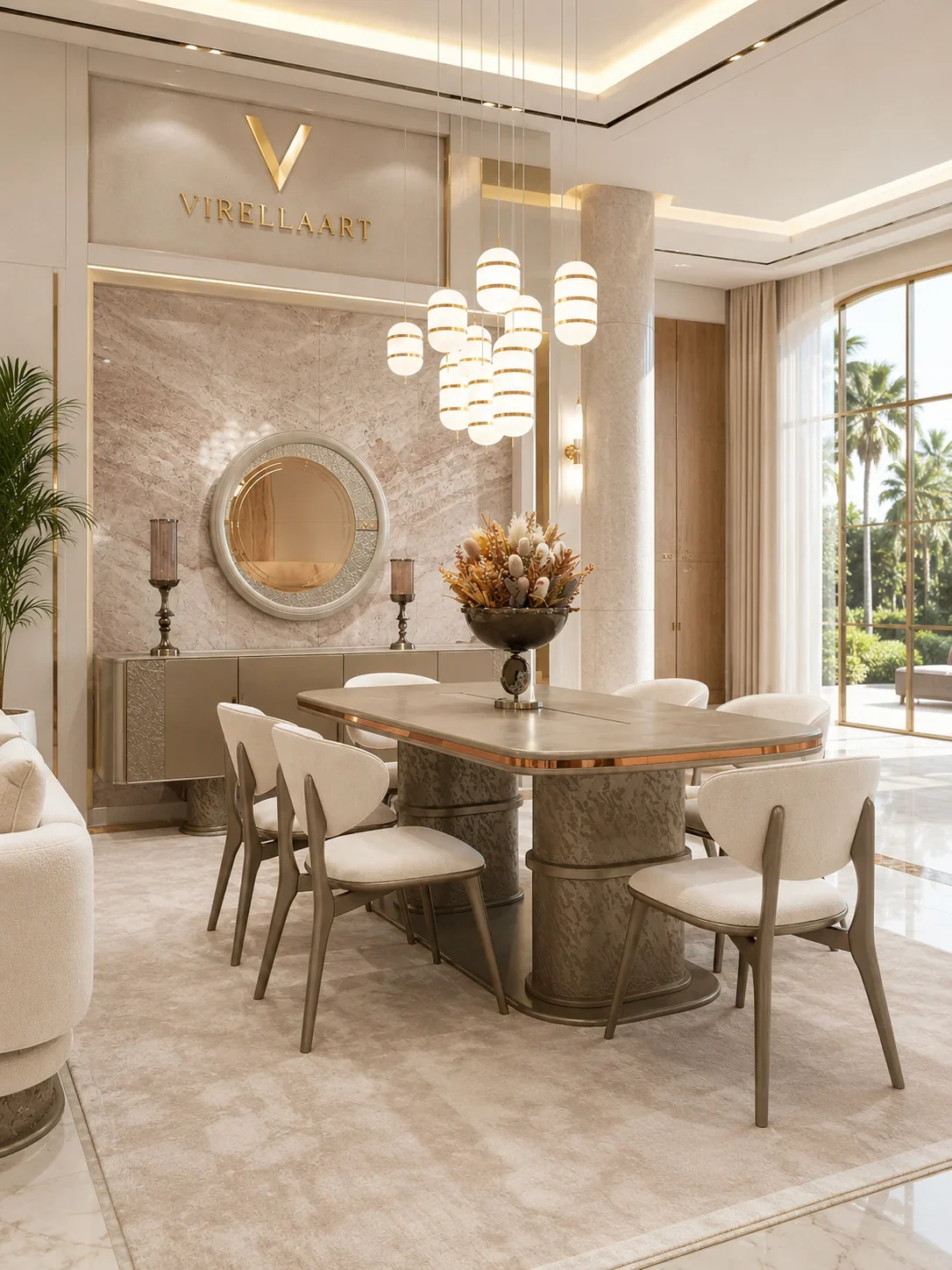
The essential decision
Choose the rug from the complete dining-table and chair-use footprint. The correct size should support every chair while it is occupied and pulled backward without restricting the surrounding circulation.
A dining-room rug visually anchors the table and chairs as one composition. When its dimensions are correct, the seating feels connected and the table gains a clear relationship with the surrounding room.
A rug selected only from the tabletop size is often too small. Chairs move beyond the table edge during normal use, and the rug must support this movement without rear legs repeatedly leaving the textile.
1. Measure the complete dining room
Record the room width and length, then mark doors, windows, columns, radiators, fireplaces, consoles and the principal circulation routes.
Measure the usable floor area rather than the empty wall-to-wall dimensions. Permanent furniture and architectural projections can reduce the space available around the rug.
Create a complete floor plan
Draw the table, every chair, the console and nearby furniture from above. Use complete external dimensions rather than estimating from photographs.
Ourcomplete room measurement guideexplains how to document usable space, furniture clearance and delivery access.
2. Record the complete dining-table dimensions
Measure the table length, width and shape. Include decorative projections, curved ends and any extension leaves that may be used regularly.
An extendable table should be evaluated in both its closed and fully extended positions. The rug must support the arrangement that will be used most often.
Include the table base
Corner legs, central pedestals and sculptural supports affect chair positions. Record the complete base because it determines where users can sit comfortably.
Ourdining table size guideexplains how to plan seating capacity and the complete table footprint.
3. Include dining-chair movement
Measure each chair from its widest and deepest points. Armrests, curved backs and decorative frames may increase the external dimensions.
Chairs must move backward before users sit or stand. Mark both the normal dining position and the pulled-out position on the floor plan.
Keep rear chair legs supported
The rug should extend far enough beyond the table so the rear legs remain on the textile during normal movement. A narrowly fitted rug can cause chairs to catch on the rug edge.
Different chair models require different movement areas. Wide armchairs at the table ends may need more rug extension than armless side chairs.
Ourdining chair size guideexplains how to calculate chair width, height and spacing.
4. Choose rug width from the table and side chairs
Rug width should include the table width, chair depth on both sides and sufficient movement area. Measure from the outermost pulled-out chair position rather than the tabletop edge.
A rug that ends beneath the centre of the chairs may look proportionate while they are pushed inward but become impractical during use.
Check nearby walls and furniture
Compare the proposed rug width with the room, console and surrounding circulation. The textile should not extend into doorways or create an awkward narrow strip of flooring.
Controlled visible flooring around the rug helps define the dining zone and maintain a clear relationship with the room architecture.
5. Choose rug length from the end-chair positions
Rug length must support chairs at both ends of the table. Include armchair depth, movement and the possible extended-table position.
End chairs often move farther backward because users approach them from different directions. Test these positions individually rather than assuming every chair requires the same area.
Consider serving circulation
People carrying plates and serving pieces should be able to move around occupied chairs without stepping through a narrow gap between the rug and nearby furniture.
Mark the proposed rug outline with removable masking tape and test the room while several chairs are pulled outward.
Continue with ourluxury dining room buying guideand explore theVIRELLAART dining room collection.
6. Select a rug shape for the table arrangement
Rectangular rugs
Rectangular rugs suit many rectangular and oval dining tables. Their long axis reinforces the principal direction of the furniture and room.
Square rugs
Square rugs can support square tables and balanced conversation layouts. The rug must remain large enough for chairs on every side.
Round rugs
Round rugs can work beneath round tables and soften the composition. Their diameter must include every chair in its pulled-out position.
Oval rugs
Oval rugs can reinforce curved or oval tables while preserving a long dining-room axis. Their widest and longest measurements must be checked separately.
Mixing table and rug shapes
The rug does not always need to match the table shape. A round table can sit on a square or rectangular rug when the complete arrangement remains balanced.
The room architecture, table position and chair movement are more important than following a fixed shape rule.
7. Protect clearance around the dining console
Measure the distance between the rug, chairs and console. Cabinet doors and drawers must open while dining chairs are in normal and pulled-out positions.
A rug that extends beneath the console may visually connect the furniture but can also make the dining zone appear too large or create uneven cabinet support.
Maintain stable furniture placement
Console legs should normally stand on one consistent floor level. Avoid arrangements where some legs rest on the rug and others remain on the bare floor.
Ourdining console size guideexplains how to plan drawer access, serving space and circulation.
8. Evaluate material, pile and maintenance
Dining rugs must support frequent chair movement and everyday cleaning. Pile height, fibre, texture and construction affect comfort, stability and maintenance.
A very thick or soft pile can make dining chairs difficult to move and may reduce stability. A flatter surface often supports smoother chair movement.
Consider spills and cleaning
Food and drink increase maintenance requirements. Select a rug suitable for the expected use and follow the textile manufacturer’s care guidance.
Colour and pattern can help conceal minor marks, but maintenance suitability should not be judged from appearance alone.
Coordinate colour and visual weight
Compare the rug with the table finish, chair upholstery, console, chandelier, flooring and wall details.
Dark or strongly patterned rugs can create greater visual weight. Lighter and quieter surfaces may make the dining arrangement feel more open.
Use a suitable rug pad
A compatible rug pad can improve stability and protect the flooring. Its dimensions should remain within the rug perimeter and suit both textile and floor materials.
Avoid common dining-rug mistakes
Do not select the rug from the tabletop dimensions alone, ignore pulled-out chairs or forget an extended-table configuration.
Another common mistake is choosing a rug that fits the table but leaves end chairs close to the textile edge during normal use.
9. Test and prepare the final arrangement
Mark the complete rug outline with removable masking tape. Place or mark the table and every chair within this area.
Pull every chair backward, walk around occupied positions and open nearby console doors or drawers. Repeat the test with the table extended where applicable.
Photograph the proposed layout from the dining-room entrance and opposite corners. These views reveal whether the rug feels proportionate to the complete room.
Provide the room, table and chair dimensions, preferred rug placement, colour direction and destination when discussing the full dining-room project.
VIRELLAART supports international clients with made-to-order furniture selection, order coordination and worldwide delivery planning from Istanbul.
Information to prepare
- The complete room width and length
- The dining-table width, length and shape
- The table size in extended form where applicable
- The complete chair width and depth
- The pulled-out chair positions
- The console dimensions and clearance
- Room photographs from multiple viewpoints
- The destination city and country
Final dining room rug checklist
VIRELLAART guidance
Choose the rug from the complete table-and-chair footprint
The right dining-room rug size supports every chair during normal movement while connecting the table arrangement and preserving circulation.
VIRELLAART can review room, table and chair information when discussing a complete luxury dining-room arrangement and made-to-order furniture options.
Frequently asked questions
Dining room rug size FAQ
How large should a rug be under a dining table?
The rug should extend beyond the table far enough to support chairs in both their normal and pulled-out positions. The correct dimensions depend on the table, chair size and room circulation.
Should all dining-chair legs remain on the rug?
The rug should ideally support all chair legs while users sit, stand and move the chairs backward. Rear legs repeatedly leaving the rug can feel uncomfortable and disrupt the arrangement.
Should the rug match the dining-table shape?
Matching shapes often creates a clear composition, but the best choice depends on the table, chair arrangement and room architecture. A rectangular rug can also support some round or oval tables.
How can I test dining rug size before ordering?
Mark the complete rug dimensions with removable masking tape, place the table and chairs within the outline and test every chair in its pulled-out position.
Can a rug be used beneath a heavy dining table?
Yes, when the rug construction, pile and floor protection are suitable. The table and chairs must remain stable, and the textile should suit the intended maintenance requirements.